
ERA systems
in all weather conditions
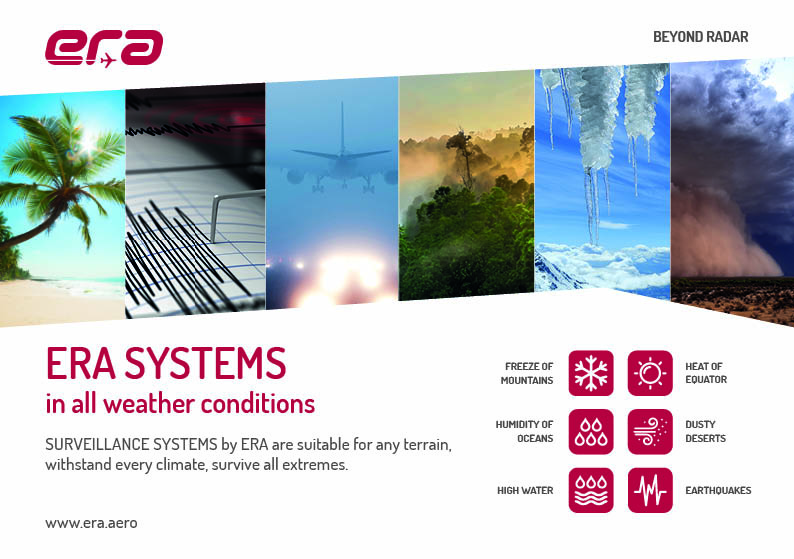
ERA exports its products to 67 countries, hence its airspace surveillance systems benefit the safety of air traffic management on all continents. One of the main reasons the systems are so popular among customers worldwide is the simple fact, that they are highly reliable in terms of MTBF (Mean Time Between Failures). They function 24/7 through the whole life cycle without any major maintenance needed, despite the harshness of the environment prevalent in the particular countries. ERA systems are designed to be universal. They accommodate to very different, even opposite, climate conditions and survive the extremes of specific weather. They withstand the freeze of the mountains and heat of the equator, the humidity of oceans or rain forests and the micro-sand of dusty deserts. They keep going under fog, wind splashes, heavy rain and are even able to survive through floods and earthquakes.
Thanks to such desirable resilience, the systems could be (and are) installed on the peaks of the Remarkables mountains in New Zealand or in mountainous areas of Kyrgyzstan or Georgia, where the antennas are permanently covered by frost. ERA has two systems in use under the world roof-top of the Himalayas in Nepal and Bhutan. All these countries value the systems which are able to perform maintenance-free at remote and several thousand metres above sea level located places, often reachable only by helicopters. In addition, the systems are ‘go green’ ones with a low energy consumption obtained from wind mills or solar panels and as such are not any burden to the unique pristine environment.
ERA systems also proved to be resilient to extreme heat in countries like India, Egypt or Turkey and in the Middle East and have shown to be dust-proof in sandy storms with regular appearances in the deserts of Oman and the United Arab Emirates. They also cope with the high air humidity in countries covered by rain forests, for instance Fiji, Malaysia and Sri Lanka, and can face durable rains in the regions near the ocean such as the green islands of the Azores influenced by the Atlantic. Similarly, ERA systems are often used in foggy places: legendary misty London or Amsterdam. Its Schiphol airport holds a record for the number of SQUID squitter beacons by ERA (ca 400 pieces) used as a vehicle tracking system in low visibility conditions.
ERA systems repeatedly survived even extreme natural catastrophes: in the African state of Namibia, the ERA modules held on to provide the data after being immersed in water as part of floods. Japan, Singapore and Indonesia, as countries threatened by earthquakes, also choose them to rely on their survivability and redundant functioning.
The vibrations are also a challenge for ERA systems on oil platforms in the oil rigs of the North Sea and Caspian Sea where they monitor the traffic of helicopters. The vibrations are caused by wind and heavy sea waves making ERA systems not only waterproof, but also windproof.
In one sentence: ERA systems are reliable under all circumstances!