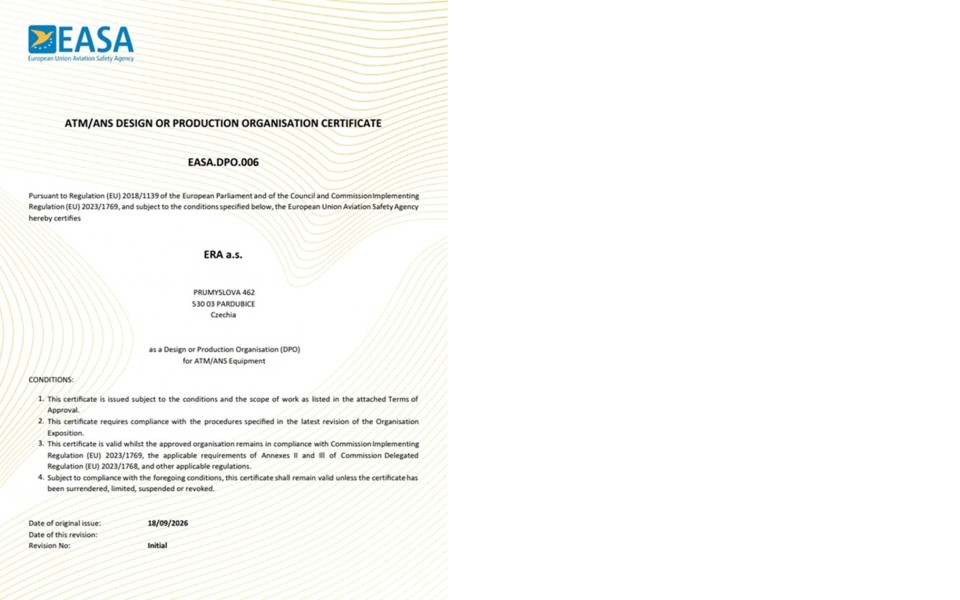
ERA becomes the first company in the world to obtain EASA DPO certification for MLAT and ADS-B technologies
ERA has successfully obtained EASA Design and Production Organisation (DPO) Approval for ATM/ANS equipment from the European Union Aviation Safety Agency (EASA). The approval covers the design and production of ERA’s key surveillance technologies, including Multilateration (MLAT), Wide Area Multilateration (WAM) and ADS-B. ERA has thus become the first company in the world to receive this certification.
The approval confirms ERA’s capability to design and manufacture equipment for (Air Traffic Management/Air Navigation Services (ATM/ANS) in accordance with the demanding European regulatory, safety and quality requirements established under the EASA regulatory framework. It provides further recognition of ERA’s long-standing expertise in the field and strengthens the company’s position as a leading European provider of surveillance technologies for civil aviation.
ERA is the first company with MLAT, WAM and ADS-B surveillance products to successfully achieve EASA DPO Approval worldwide. The DPO Approval is particularly significant for ERA as it applies directly to the company’s established MLAT technology, which ERA has been a pioneer developer of for three decades. These surveillance systems provide critical data to air navigation service providers worldwide, supporting efficient and reliable global air traffic operations.
“For ERA, the DPO Approval is more than a regulatory milestone. It demonstrates the company’s commitment to maintaining high standards throughout the entire product lifecycle — from design and development through production and delivery. The approval enhances ERA’s ability to provide its surveillance technologies to the European and global ATM market,“ stated ERA CEO Ondřej Chlost.
On MLAT technology
Multiltaeration is a navigation and surveillance technique that determines the precise location of an object (mostly aircraft) by measuring the Time Difference of Arrival (TDOA) of a signal received by multiple separate stations. By comparing tiny differences in signal arrival times, a central computer uses hyperbolic geometry to pinpoint the object's position.